The gargoyles returned to Fr Primwell, coursing the moonlit skies with triumphant wings.
One of them, Clutch of the Grotesque Claw, had a sombre announcement.
“Perchwick is dead.”
Fr. Primwell’s heart sank. Perchwick —
Morally —
Lifeless.
Clutch let out a dramatic sigh.
“The townspeople have started —
Dying.
The very thing you are afraid of, Father.”
They wanted Perchwick administratively —
Alive. Mortality needed correction.
Dead torches were replaced.
Candles were relit.
Rewound watches ticked.
Death lived.
Another successful Gargoylian campaign.
But Fr Primwell sighed.
The good priest nodded in resigned understanding.
They hadn’t defeated death —
Merely erased it temporarily.
Mortality still needed convincing.
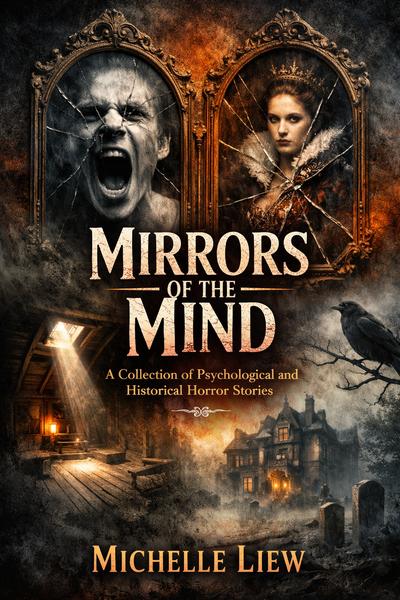
Mirrors of the Mind by Michelle Liew is a collection of psychological and supernatural short stories that explore the quiet unease beneath ordinary moments. These are not tales of spectacle, but of subtle fracture — where memory distorts, silence speaks, and the self is not always singular. In these stories, what is unseen often carries the greatest weight, and what lingers is not what is shown, but what is felt.
A man dismisses an anonymous warning—until every knock proves someone knows exactly where he is.
Daniel found his way home after a long day of dodging well-meaning teachers.
On the kitchen table lay a single, yellow sticky note that no one in his dysfunctionally disorganised family would have left
In unhurried, careful handwriting.
Obvious.
Cryptic.
Thoughtful.
“Whatever happens, don’t answer the door. “
There was no signature. Not from anyone in his scatterbrained family.
Daniel chortled and crumpled the short directive.
It didn’t matter who left the note.
The person was wasting a precious resource.
TIME.
Curiosity eventually overcame his scepticism.
Daniel had to know who left that annoying note.
He questioned neighbours.
Badgered family.
Scoured the patio.
Nothing could explain the mysterious sticky note.
Building security showed that nobody had entered the apartment.
The explanation had to be logical.
Rational.
A burglar.
The landlord.
The cat.
All surely explained the note’s ambiguity. Reason invented excuses faster than fear could explain them
Then —
Knock.
Knock.
Knock.
Slow. But sure. Every explanation collapsed with the next knock.
No one.
But the silence seemed louder than words.
The knocking continued.
On the front door.
The back door.
The bedroom window.
The lights went on and off in uncanny sync.
Daniel, convinced that someone was playing him for a fool, peered outside the window.
He didn’t care who left that note.
Before he opened the door, Daniel noticed something on the reverse side of the note.
He flipped it over.
A second, more cryptic sentence.
“It learns who ignores warnings.”
No more knocks.
Total silence.
Daniel smirked.
“Nice try.”
The bedroom door
Slowly.
Swung.
Shut.
Another note.
On the bed.
Daniel picked up the picture, fingers trembling.
“I left the first note. You should have believed yourself.”
Then a recognisable scent.
A familiar voice.
“Unlike me.”
He spun around wildly.
And framed by the doorway —
Himself.
With a knowing smile.
Mirrors of the Mind by Michelle Liew is a collection of psychological and supernatural short stories that explore the quiet unease beneath ordinary moments. These are not tales of spectacle, but of subtle fracture — where memory distorts, silence speaks, and the self is not always singular. In these stories, what is unseen often carries the greatest weight, and what lingers is not what is shown, but what is felt.
A Horror Comedy of Spotless Streets and Hidden Sin
Image created with Chat GPT
The gargoyles returned to Fr Primwell, flying with monstrous pride.
“The posture in Perchwick is perfect, Father.” One of them declared triumphantly.
Fr. Primwell nodded sagely —
“Good. I’m sure you’ve elevated everyone’s —
Positions.”
“But everything in Perchwick is so…sordid.” One gargoyle complained. “Our next improvement campaign is eliminating sordiness.”
Fr. Primwell nodded — then worried about how clean they wanted Perchwick.
Pristine didn’t quite suit the ordinary town.
The gargoyles tried everything in their attempt at —
Sanitisation.
Everything had to sparkle.
They removed caked mud from sidewalks.
Cleaned windows that seemed unclear.
They scrubbed every speck of dirt off walls.
They hid gravestones that looked grimy.
They confiscated any artwork that looked remotely like —
Picasso’s.
All evidence of untidiness was removed — Perchwick deserved ultimate moral hygiene.
The townfolk, all concerned for the ethical well-being of their children, applauded the gargoyles’ dedication.
Fr. Primwell flinched. “Aren’t you being a little too —
“Prim?”
But the gargoyles? They grinned their sinister grins and flapped enthusiastically.
The streets were so spotless that they became the town’s main —
Distraction.
And while everyone’s attention was occupied, genuine evil saw its opportunity to grow.
The mysterious monsters continued to congregate beneath the town’s abandoned chapel.
Their activities became increasingly —
Sinister.
Their dire plans took shape, becoming damaging, and —
Sordid.
They stirred mischievousness in the hearts of Perchwick’s unsuspecting
citizens.
Irreverent.
Then bold.
Unnoticed because of their perfect neatness.
While the evil in the town was approving —
Inspection.
Mirrors of the Mind by Michelle Liew is a collection of psychological and supernatural short stories that explore the quiet unease beneath ordinary moments. These are not tales of spectacle, but of subtle fracture — where memory distorts, silence speaks, and the self is not always singular. In these stories, what is unseen often carries the greatest weight, and what lingers is not what is shown, but what is felt.
Celery was a town that did the bitter-truth vegetable proud.
Townsfolk were honest. And dishonesty had an odd side effect.
Every lie sprouted celery stalks. And soon enough, the sticks of celery engulfed unsuspecting t liar’s home.
Townsfolk thought that it was just a nuisance at first. After all, white lies never hurt anyone. They cost only a stalk or two.
No one really bothered.
But the celery stalks increased —
In size, frequency and scale.
Soon, every home had a patch. Celery appeared —
In cupboards. In drawers. On roofs.
The mayor’s living room was so full, he started a garden.
Businesses advertised guarantees — and sold celery patches on the side.
Celery became the town’s best-known export.
But the stalks multiplied so fast, everyone made celery fondue.
The mayor invited esteemed researchers to investigate the phenomenon.
They each wore thinking caps —
Made of celery.
But made an honest discovery.
The celery had no roots.
No one had truly grown celery. The stalks matched missing produce from other towns.
The townsfolk stopped lying —
And celery exports at twice the cost of “growth.”
The neighbouring towns accepted the returning celery —
With people drinking “As-Is Celery Juice.”
From stalks with roots.
The honest taste was no longer bitter —
But rather refreshingly sweet.
Mirrors of the Mind by Michelle Liew is a collection of psychological and supernatural short stories that explore the quiet unease beneath ordinary moments. These are not tales of spectacle, but of subtle fracture — where memory distorts, silence speaks, and the self is not always singular. In these stories, what is unseen often carries the greatest weight, and what lingers is not what is shown, but what is felt.
“The photocopier is intact. Your stapler remains on the table. The document stays half-finished.
Please carry on until further notice.”
Certainty became suspicious.
Trevor lowered his pen.
“Should we…
Evacuate?”
But habit proved too hard to escape.
At the office, normal was urgent.
Mirrors of the Mind by Michelle Liew is a collection of psychological and supernatural short stories that explore the quiet unease beneath ordinary moments. These are not tales of spectacle, but of subtle fracture — where memory distorts, silence speaks, and the self is not always singular. In these stories, what is unseen often carries the greatest weight, and what lingers is not what is shown, but what is felt.
“Hello?” Trevor’s impatient baritone barked across the line. It was Tuesday, and the usual paperwork routines had to be observed before meetings.
The caller on the other end fell silent in sad apology. “Sorry, sir. This wasn’t the number I meant to dial.”
The Insurance Manager paused at the despondent ring in the caller’s voice, then righted himself at the thought of the paperwork he still had to finish.
“Well…since I’ve got you on the line, perhaps you’d give me a bit of advice. I don’t know which suit to wear to my daughter’s wedding. Purple would be garish, but is SO me. Black is blah, but safe. What do YOU think?”
Trevor paused, then answered the rather desperate voice. “Well….” “Thought so. Purple has always been my favourite colour. Thanks, man. I’ll make sure to tell my friends about Trevor’s Heartline.”
Trevor glanced at the receiver, flummoxed.
Word spread faster than poor Trevor’s confusion. Over the week, Trevor received more phone calls at the office. Each began with “This wasn’t the number I meant to dial.”
An increasingly overwhelmed Trevor began dispensing increasingly random advice to flustered callers.
“Trevor, my mother won’t let me go out with this cute boy from school. What should I do?”
“Listen to her.“Oh, Trevor, my boss has given me an impossible task.”
“Tell him to finish it himself.”
“Trevor, the neighbours sing loudly outside my home at 6:00 a.m. every morning. What should I do?”
“Go out and sing with them.”
Strangely, every single suggestion —
Worked.
The gifted counsellor soon had to field recommendations. And he had no idea why.
Trevor’s Heartline —
Won hearts. Way more than he expected.
Journalists clamoured to interview him. He became a familiar face at podcasts.
A radio station sought him out, and he soon hosted his own counselling show.
Listeners found his avant-garde advice —
Engaging.
Experts praised his refreshingly unconventional methodology.
Counselling professionals lauded his authenticity.
Trevor, wracked beyond belief, insisted that his counselling qualifications were “ten grades below zero.”
“I’m an insurance salesman…”
But his humility earned him even more fans.
Especially female ones.
No one listened to his explanations.
A journalist finally uncovered the bald truth after hours of surreptitious surveillance.
Trevor really knew —
Nothing.
She gave the hassled podcast counsellor reprieve in an article with the headline:
“This wasn’t the number I meant to dial.”
Trevor read it and heaved a sigh of relief.
And received a new phone call.
“Help me, Trevor! Should I go with a grey or blue jacket?”
Trevor sighed.
Mirrors of the Mind by Michelle Liew is a collection of psychological and supernatural short stories that explore the quiet unease beneath ordinary moments. These are not tales of spectacle, but of subtle fracture — where memory distorts, silence speaks, and the self is not always singular. In these stories, what is unseen often carries the greatest weight, and what lingers is not what is shown, but what is felt.
And the dark ink was fodder, rich, for the unseen.
And after each blessed census, recorded, done —
The residents’ written fears strangely vanish, gone
Chillsville’s folk cheer wildly, now no longer afraid
Joy is but a minute, with words penned in vain.
Then Census Sally, with observant eye, then sees,
In the penned records, faults, small inconsistencies
She brings them forth, at a town meeting, all outpoured
They are cast aside, pointedly, all ignored.
And Census Sally visits Chillsville’s final home,
Where a blank census lay, a silent tomb.
In a creased corner, in dark ink, their meaning plain —
Two words, their cursive clear — -
Chillsville’s names.
Mirrors of the Mind by Michelle Liew is a collection of psychological and supernatural short stories that explore the quiet unease beneath ordinary moments. These are not tales of spectacle, but of subtle fracture — where memory distorts, silence speaks, and the self is not always singular. In these stories, what is unseen often carries the greatest weight, and what lingers is not what is shown, but what is felt.
It surrounded the Hollow Caller, said to claim people whenever called.
The legend had been —
Repeated. Retold. Repeated.
Believed— unequivocally.
Seasoned traveller Wanda Ling felt the unsettling vibe.
Old footprints.
Shattered tools
A memorial — hardly remembered.
Residents told her that townsfolk vanished after a dangerous bridge crossing — a bridge left unrepaired.
Wanda faced the residents during a town hall meeting.
“There is no Hallowed Caller. People vanished when they crossed the bridge.”
But one whisper became another—
And another.
Those in the town hall frantically chanted his name…
“Hallow…Hallow…Hallow…”
And the forest answered —
“Afraid.”
The bridge remained empty.
Wanda left.
The fresh footprints had returned to the forest.
A child. Of the woods…or of fear.
Mirrors of the Mind by Michelle Liew is a collection of psychological and supernatural short stories that explore the quiet unease beneath ordinary moments. These are not tales of spectacle, but of subtle fracture — where memory distorts, silence speaks, and the self is not always singular. In these stories, what is unseen often carries the greatest weight, and what lingers is not what is shown, but what is felt.
Monday morning fell on the busy town of Rushmore. The bullet train, as usual, was crowded. It breathed with quiet fatigue. Office workers had grown accustomed to swaying with every bend in the track. Bags bumped into backs. Mobile phone screens glowed in sleepy hands. But one seat seemed politely — Spare. Not occupied. Spare. Not noticed. Spare. Day. After. Day. Commuters looked at it, then away. No one hurried to fill it. I didn’t.
And the seat remained — Unfilled. Every morning. Someone would approach it enthusiastically. Or cautiously. Then hesitate. A fatigued office worker would approach it — Sit. Then stand again. A student would shift towards it and end up squeezing beside strangers. The behaviour repeated with curious precision. No one said a word. No one gestured. The avoidance was natural — Rehearsed. The silence, practised. As though there was an unwritten rule that everyone understood. But me.
Commuters filled the train after an exhausting day. A tough day at work. I was dog-tired. The seats wouldn’t have me — They were all — Occupied. All except — - The Vacant One. My legs couldn’t sync with my unanswered question. I sat. The cushion surrendered without complaint. Relief outweighed curiosity. For that moment. Nothing happened. The seat provided much-needed comfort. I grinned at my own ridiculousness. Then my eyes fell on the passengers. No one looked at me. They gazed — Beyond my shoulder.
The train reached the next station. Everyone stepped over the platform gap. Hurriedly. But quietly. No one dared look at me. The doors shut, and there was nothing but — Silence. The carriage seemed much larger than before. The spare cushion — Sank. Its fabric dipped by the tiniest fraction. And then — A voice. It pressed my ears, very gently. But purposefully. I breathed in. Something followed. The train went on.
Mirrors of the Mind by Michelle Liew is a collection of psychological and supernatural short stories that explore the quiet unease beneath ordinary moments. These are not tales of spectacle, but of subtle fracture — where memory distorts, silence speaks, and the self is not always singular. In these stories, what is unseen often carries the greatest weight, and what lingers is not what is shown, but what is felt.